


We Swam a Fjord in Winter & Lived to Eat Waffles: The Truth About Arctic Floating

Updated: 2 days ago
Arctic floating looks like an extreme survival skill, and it is, but here’s why you should try it and everything the tour operators politely forget to mention.

It’s actually oddly serene… until someone splashes you.
The dry suit was meant to be dry.That theory held… briefly.
We slid into a snow-fringed fjord expecting theatrics. Shal, a woman who gets numb fingers and toes at 15°C (60°F) in an air-conditioned supermarket in July, was preparing for frostbite-level regret.
Instead? Shal floated. Calmly. Peacefully. Suspiciously comfortably.
We didn’t feel warm. We didn’t feel cold either. It was neutral. Manageable. Almost relaxing.
Then they had us link into a survival formation and race the other half of the group. James is a splashy swimmer.
Icy ribbons of seawater slipped down the neck of Shal’s dry suit. That’s when the Arctic politely reintroduced itself.
If you’re curious, this is the exact Arctic floating tour we booked.
CONTENTS
We’ve included what we paid with currency conversions based on current exchange rates to help with planning, but things change, so it’s always worth double checking to dodge any last-minute surprises.
THANK YOU FOR YOUR SUPPORT!
This post has affiliate links, which means we may earn a teeny commission if you book through them (at no extra cost to you). We only recommend what we’ve road-tested, adored, or nearly booked ourselves. Your support helps keeps our adventures going – thank you.
WHAT IS ARCTIC FLOATING?
Arctic floating is a guided experience where you wear a full survival dry suit and drift in an icy fjord while snow settles quietly around you. The suits are buoyant, heavily insulated and designed to keep you afloat with minimal effort.
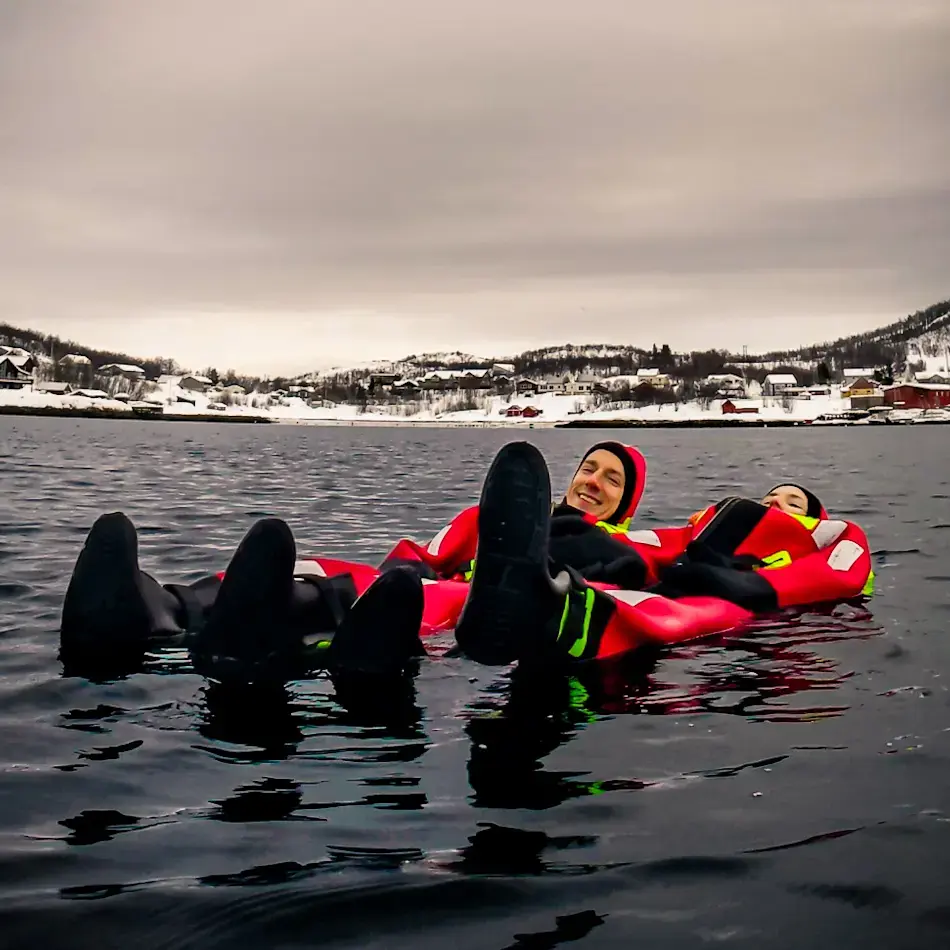
It looks dramatic. It feels surprisingly meditative.
You’re trying out a few survival drills, not swimming lengths. Aside from a few minute race, you’re bobbing gently, staring at mountains, occasionally rotating like a very well-dressed seal unless you opt to jump off the pier at the end.
We did this with 10x North, and we’d book the same one again.
HOW ARCTIC FLOATING STARTED
Arctic floating didn’t begin as a quirky tourist activity. It came straight out of cold-water survival training for maritime crews, aviation personnel and polar researchers.

While cold plunges are an ancient Nordic tradition, this version, floating in specialised immersion suits, was developed for one reason: survival. If someone falls into freezing water, cold shock and panic are what kill first.
The training teaches you to override that instinct, relax, keep your airway clear and quite literally float to live.
The float only works because of the gear. These waterproof, insulated, highly buoyant survival suits are engineered to keep you afloat and slow heat loss in near-freezing conditions. The tour we chose uses the full immersion survival suits originally designed for open-ocean emergencies.
What began as high-stakes, life-saving instruction eventually evolved into something unexpected. Operators in Lapland realised that once the panic element was removed and proper supervision added, the experience felt oddly peaceful.
So now, instead of preparing for disaster, you’re calmly floating in 8°C (48°F) or colder water, often among ice, in equipment originally designed to keep someone alive in open ocean.
It’s still controlled. Still supervised. Still serious gear.
Just with fewer helicopters involved.
WHAT IT FEELS LIKE
The first surprise is how stable your temperature feels. The suit traps insulating air and keeps the freezing seawater out. At least, that’s the goal.

If water sneaks in, usually at the neck seal or the crotch seam where the suit is most vulnerable, you’ll notice it instantly.
Here’s the curious part. Even though the water is freezing when it enters, it gradually warms to your body temperature once trapped inside the suit. So you’re not constantly being shocked by icy currents.
But does that mean you won’t feel chilled? Not quite.
You’re still aware that something cold invited itself in. Your fingers and toes, especially towards the end, will begin to feel it. That was our experience. Perfectly fine at first. Quite chilled by the finale.
DRY SUITS
There are lighter recreational dry suits used for diving and water sports. Then there are heavy-duty immersion suits designed for maritime survival.

Arctic floating typically uses the top-of-the-line, bright orange immersion suits intended for up to seven hours of survival in open ocean conditions. These are the serious ones. The “if the ship goes down, this is what the crew wears after they evacuate everyone else into lifeboats.
The outside is rinsed after use because you’re floating in seawater and then hung to dry. They don’t smell. But if you’re particular about hygiene, plan accordingly.
WHAT TO WEAR INSIDE A DRY SUIT

James wore:
Icebreaker merino wool 260 base layer top
Synthetic thermal top
Tesco fleece trouser
Danish Endurance sock liners
Danish Endurance merino wool socks
Shal wore:
Icebreaker merino wool 260 base layer top
Thin merino sweater
Mountain Warehouse thermal leggings
Bridgedale synthetic sock liners
Finisterre merino wool socks
It worked well overall. That said, James regretted not wearing merino 260 base layer tights. His fleece trousers caught on the inner lining of the suit and rucked up far too easily, which is not what you want when you’re trying to feel streamlined in a survival suit.
We both agreed that a heavier fleece on top and merino liner gloves worn underneath the knit gloves provided would have been very welcome additions. Our fingers were the first to negotiate with the cold.
You can’t wear anything under the hood. If you have long hair, it must be tied back in a ponytail, not a bun, so the seal can sit properly against your neck and jaw. The hood needs to fit snugly around your face to keep water out.
If you’re wary about communal suits and the thought of your fjord-damp hair touching your clean hat afterwards, bring either a sacrificial hat or a swim cap for after you’re out of the suit. James went with an old hat he didn’t care about. Shal brought a swim cap to wear underneath her dry clean only hat.
And yes, bring a full change of clothes. Even if you think you’ll stay dry. Even if your other half promises not to splash you. Especially then.
AFTER THE FLOAT: WAFFLES, BRUNOST & HONOURS
Once you’re back on land, you warm up indoors with hot drinks, fresh waffles and funnily enough an awards ceremony.

We know you’re not here for the certificates. You’re here for the waffles.
They’re served with brunost, Norway’s famous brown cheese. Made from caramelised whey, it’s sweet, faintly fudgy, and nothing like what you imagine when someone says “cheese.” You shave it into delicate slices and layer it with jam over warm waffle squares.
If you’re adding Arctic floating to your itinerary, this is the tour we used.
FREQUENTLY ASKED QUESTIONS
Is Arctic floating safe?
Yes, when done with a reputable operator. You’re supervised the entire time, wearing professional immersion survival suits, and never left to drift off into the horizon. It feels extreme, but it’s carefully controlled.
How cold is the water?
Typically around 8°C (48°F) or colder, sometimes with ice present. The suit insulates you, but if water sneaks in at the neck or seams, you’ll feel it before it warms to body temperature.
Do you get wet?
You’re supposed to stay dry. However, small leaks can happen, especially at the neck seal or crotch seam. The water will go down your neck if you opt to jump off the pier. Bring a full change of clothes, just in case.
What should you wear inside the suit?
Think merino base layers, a heavy fleece and proper wool socks.
The tour guides wore just a single merino layer under their suits. We absolutely would not have been warm enough in that.
They provide knit gloves to wear inside the suit, but we wished we’d brought merino glove liners to wear underneath for an extra layer of warmth.
Layer smart so you can peel off the outer layer that touched the communal suit before climbing back into your clean jacket.
Can you wear a hat?
No. The hood of the suit must seal tightly around your face.
Is Arctic floating worth it?
If you’re drawn to experiences that sound dramatic but feel unexpectedly serene, then yes. We did it for the story and the novelty and ended up genuinely loving it. We recommend going with 10xNorth if you're in Tromso.
NOT QUITE DONE EXPLORING?
About to check Lapland off the bucket list? Start with our 8 Lapland Travel Tips: How We Prepared for Tromso’s Arctic Winter (And Nailed It) and exact 5 day Tromso itinerary (coming soon).
Pin this for later!
FOLLOW US ON PINTEREST