


Andong Hahoe Folk Village: How to Get There & Where We Stayed in 2026

Andong Hahoe Folk Village transported us back 600 years. Getting there was another story. Here's our advice on logistics, where to stay and why it's worth the detour.

Eight hours. That's how long it took us to reach Andong from the Boseong Tea Fields in torrential rain. South Korea's north-south transport connections are brilliant. East-west? Another story. Thankfully, if you're coming from Seoul, Andong is just 2 hours by KTX.
We'd come to explore Andong Hahoe Folk Village, a 600-year-old UNESCO World Heritage Site celebrated for its traditional hanok houses and living Confucian heritage. Even its centuries-old mask dance, an irreverent satire of the aristocracy, belongs to a separately UNESCO-listed tradition.
We'd imagined wandering its narrow lanes beneath blue skies. Instead, we got soaked. But between the rain-drenched rooftops, ancient traditions and extraordinary sense of stepping back in time, we found the magic we'd travelled all that way for.
In a Rush? Here's Our Favourite Place to Stay in Andong
If your mission is to visit the Andong Hahoe Folk Village, Rakkojae Hahoe Hanok Hotel is really the only game in town for a luxe stay. Located within the UNESCO-listed folk village, we loved exploring on foot, the beautiful hanok architecture, private mugwort steam rooms and 16th-century-inspired dining.
★★
Contents
01 Atmosphere
Affiliate disclosure: Some links in this guide are affiliate links, which means we may earn a small commission if you book or buy through them, at no extra cost to you. We only recommend things we’ve personally booked, used or packed ourselves and would recommend regardless of whether we earn a commission.
Atmosphere

There are historic villages, and then there are historic villages where you can actually sleep inside the thing you came to see. Andong Hahoe Folk Village is the latter.
The village has been home to descendants of the Ryu clan for around 600 years, with traditional hanok houses arranged around winding lanes and surrounded by mountains, farmland and the Nakdong River. It still feels lived-in rather than preserved solely for visitors, which is precisely what makes wandering around so enjoyable.
Hahoe looks like a village braced for crowds, with plenty of tourist infrastructure to suggest the tour buses arrive in force. Yet when we visited in May, even with a couple of buses bringing in domestic visitors, it was surprisingly peaceful. Perhaps it was the time of year, or perhaps the torrential rain had scared everyone off. Either way, we practically had the village to ourselves. And once the tour buses left, it was quieter still.
4 Best Things to Do in Andong Hahoe Folk Village
From centuries-old traditions to spectacular views, these are the four experiences we'd make time for in Andong Hahoe Folk Village.

Wander ancient lanes
Andong Hahoe Folk Village
Apr - Sep 9AM - 6PM
Oct - Mar 9AM - 5PM
KRW 5,000 (cash)
The best way to explore Hahoe is to forget the itinerary for a while. We spent a couple hours wandering past centuries-old hanok houses, slipping down quiet lanes and following the paths towards the river, where mountains frame the village.
Don't miss Samsindang, the 600-year-old Wishing Tree, believed to be home to a goddess who protects children and families. Write a wish on a slip of paper and tie it alongside hundreds of others.
Traditionally, the wishes are burned during lunar New Year celebrations, sending everyone's hopes into the heavens.
Opening hours don't apply if you're staying at Rakkojae Hahoe Hanok Hotel.
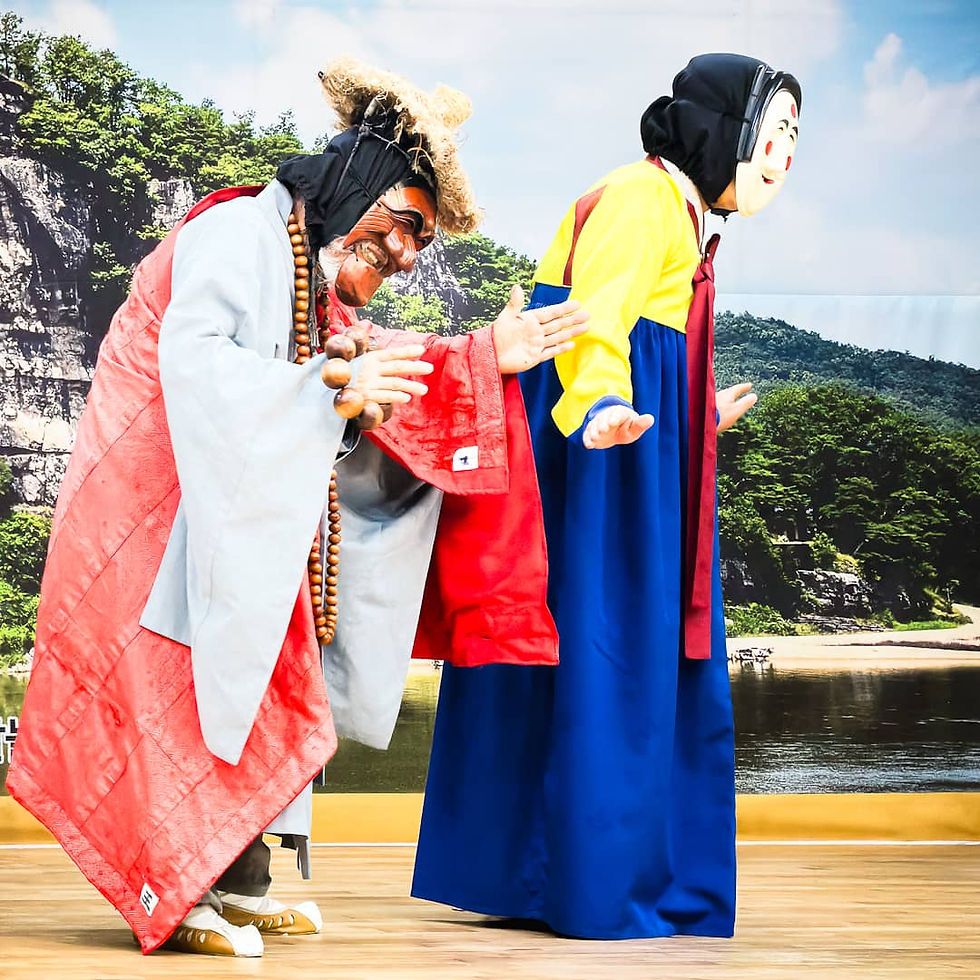
See the famous mask dance
Mask Dance
2-3PM
Jan - Feb Sat-Sun
Mar - Dec Tue - Sun
Mask Museum
Daily 9:30AM - 6PM
Entry included with village ticket
The Hahoe Mask Dance was far crasser than we expected! Bawdy sketches mocking lecherous monks and arrogant aristocrats unfold to live music, with English explanations on screens.
Legend has it that a spirit ordered a young craftsman to carve masks in isolation to protect his village. When his lover secretly peeked into his workshop, he was struck dead for breaking the sacred rule, leaving the final mask unfinished.
A few steps away is the Hahoe Mask Museum, showcasing masks from Korea and around the world.
Hike to the viewpoint
Buyongdae Cliff
24/7
Free entry
For the best view of Andong Hahoe Folk Village, make the short but steep-ish climb up Buyongdae Cliff. It takes ~10 m and delivers a spectacular view of the village curling around the Nakdong River.
Ask your hotel to arrange transport, and request for the taxi to wait while you do the climb. We arranged a flat fare for the driver to take us to the trailhead, wait and bring us back, which saved us having to work out how to get home afterwards.
Bring cash. Rural Korea has not yet entirely surrendered to the tap-to-pay revolution.

Follow in scholars' footsteps
Byeongsanseowon
Apr - Sep 9AM - 6PM
Oct - Mar 9AM - 5PM
Free entry
If you've still got time and energy, add Byeongsanseowon, a beautifully preserved 16th-century Confucian academy framed by mountains.
According to AllTrails, Confucian Culture Road begins near the western edge of Hahoe Village. Once travelled by Confucian scholars, this historic route takes around 60–90 minutes each way (4–5 km). From Rakkojae Hahoe Hanok Hotel, allow~3–4 h for the round trip, including time to explore.
We'd planned to make the trek, but the torrential rain put us off. Sadly, the one that got away.
Andong Hahoe Folk Village Travel Guide
All the practical bits you need to make your trip to Andong Hahoe Folk Village run smoothly, from where to stay and what to eat to getting around.
How Long to Visit?
We recommend 2 nights, giving you one full day to explore rather than turning up, taking three photographs and immediately getting back on a train.
Where to Stay
If your main reason for visiting is Andong Hahoe Village, Rakkojae Hahoe Hanok Hotel is really the only game in town. We loved being able to walk to the UNESCO-listed village without relying on tours or shuttle buses.

The beautiful hanok architecture, private mugwort steam rooms (complete with sauna outfits and slippers!), modern bathroom with rainfall shower, complimentary fully stocked mini bar (with drinks, snacks and face masks) and 16th-century-inspired dining make the hotel an experience in itself.

The catch? Korean kings slept on the floor, and so will you. As lovers of plush Western beds, we found it rather uncomfortable even after the hotel kindly stacked two bedrolls on top of each other for us. But the atmosphere and location were so exceptional, we're still happy with our decision.
Where to Eat
If you're staying at Rakkojae Hahoe Hanok Hotel, dining options are rather limited. There's the hotel itself, a handful of restaurants near the village entrance specialising in Andong's famous jjimdak chicken, and a few cafés and bakeries. You could take a taxi into Andong for more choice, but at 20 minutes each way, it felt like rather a lot of faff for dinner. We stayed put.
Breakfast at Rakkojae is complimentary, with a choice of Western continental or traditional Korean. We opted for Western. Fishy breakfasts aren't really our thing.
For dinner, the hotel offers a 16th-century Signature Heritage Dining experience (Suunjapbang), inspired by Korea's oldest known traditional cookbook, written by the Andong Gwon clan. Served on heirloom ceramics, the multi-course feast costs KRW 100,000 per person and requires advance booking.
Sounds extravagant? We thought so too, until we ordered Andong's famous jjimdak. What arrived was essentially a mountain of chopped chicken bones accompanied by an impressive supporting cast of fishy-smelling side dishes.

At KRW 40,000 per person, the price for Andong's famous jjimdak was shocking, especially when we felt like we were sitting in someone's kitchen with a K-drama blasting in the background. Suddenly, the hotel's elaborate heritage feast was looking like a value.
If you have a shellfish allergy, bring backup meals like Summit to Eat. Safe options are extremely limited beyond breakfast and simple bakery treats, and even those require ingredient checks.

Speaking of treats, we never quite developed a taste for Korea's red bean-filled pastries. But the condensed milk bread at the Hahoe Mask Museum cafe? We went back for more. Imagine Japanese milk bread's sweeter, stickier cousin, accompanied by a surprisingly good cappuccino.
Getting There
Take the KTX from Cheongnyangni Station in Seoul to Andong Station, which takes around 2 hours. We recommend buying KTX tickets when they are released 60 days before departure because they sell out.

From Andong Station, take a taxi (we used the app, K.Ride to order one) to Andong Hahoe Folk Village. Allow around 20 minutes for the final leg to Rakkojae.
If you're travelling to Andong from another city, don't assume the most direct route on a map is the quickest or easiest. Sometimes, going back through Seoul is actually faster.
We discovered this while travelling from Gwangju, where we'd based ourselves to explore the Boseong Tea Fields. Heading east across the country looked more logical, but the slower trains and a painfully tight connection meant we'd have spent longer travelling, with the added possibility of being stranded overnight if we missed our only connection.
So we went via Seoul instead. A rather ridiculous detour geographically, but considerably less stressful.
Getting Around
Most of the sights around Andong Hahoe Folk Village can be reached on foot if you're staying at Rakkojae Hahoe Hanok Hotel, including the village itself, the mask dance / museum and Byeongsanseowon.
Buyongdae Cliff is the exception. The trailhead is around a 10-minute taxi ride away, and ride-hailing apps aren't particularly useful once you're out the city of Andong. We asked Rakkojae to arrange a taxi to take us to the trailhead, wait while we did the hike and bring us back.
The hotel also arranged our taxi back to Andong Station when it was time to leave.
Bring cash for taxis.
Is Andong Hahoe Folk Village Worth Visiting? Our Honest Review
Absolutely. But is it worth travelling halfway across South Korea for? That depends.

We spent eight hours getting to Andong, arrived in torrential rain and still fell completely for Hahoe. Wandering its 600-year-old lanes, watching the wonderfully irreverent mask dance and sleeping in a traditional hanok made it one of our most memorable experiences in Korea.
But if your itinerary is tight, there's an easier alternative.
Add half a day to your Gyeongju itinerary and take a taxi to Yangdong Folk Village instead. It shares Hahoe's UNESCO World Heritage listing, with beautifully preserved Joseon-era houses and centuries of Confucian heritage.
The difference? Hahoe sits within a bend of the Nakdong River, with a compact layout and its famous mask dance. Yangdong sprawls across hills and valleys, offering a more architecture-focused visit, but no equivalent cultural performance.
Our verdict? If you love living traditions and unusual places to stay, Hahoe is worth the pilgrimage. But if you simply want to experience a traditional Korean village, Yangdong is a wonderful alternative without the logistical gymnastics.
Andong Hahoe Folk Village was worth the detour, but South Korea had plenty more surprises in store. So, would we recommend the country as a whole? Read our full South Korea Review →