


Vietnam 2 Week Itinerary: The Best Route from South to North

Updated: Apr 17
Our Vietnam 2 week itinerary following the best route from south to north, covering must-see highlights without wasting time. Fast-paced but considered, with iconic stops, smart logistics, and just enough breathing room.

You can cover a lot of ground with a Vietnam 2 week itinerary This route runs from the buzz of Ho Chi Minh City in the south to lantern-lit evenings in central UNESCO-listed Hoi An to UNESCO heavy-hitters in the north, including Ninh Binh and a sail through Ha Long Bay, all without feeling like a mad dash.
If you have more time, our Vietnam 3 Week Itinerary: Highlights & Hidden Gems from South to North takes this route further, with a slower pace and a couple offbeat destinations where few tourists venture.
CONTENTS
We’ve included what we paid with currency conversions based on current exchange rates to help with planning, but things change, so it’s always worth double checking to dodge any last-minute surprises.
THANK YOU FOR YOUR SUPPORT!
This post has affiliate links, which means we may earn a teeny commission if you book through them (at no extra cost to you). We only recommend what we’ve road-tested, adored, or nearly booked ourselves. Your support helps keeps our adventures going – thank you.
VIETNAM: GOOD TO KNOW
If it's your first time in Vietnam, don't miss our 15 essential travel tips, including how to cross the street without panicking and a few other handy nuggets we learned the hard way.
TOURIST VISAS
If you're a UK citizen you can visit Vietnam for up to 45 days without a visa. Here's a list of countries exempt from visas. If you're a US citizen, a visa is required for any stay.
Your passport must be undamaged, valid for at least 6 months from arrival, and have two blank pages. Visa rules can change, so double-check official government guidance before you fly.
HEALTH
No vaccinations are required for entry, but it’s sensible to be up to date on routine jabs unless advised otherwise by your doctor. We chose to get rabies, as Vietnam is considered high-risk by the WHO, and Japanese encephalitis due to time spent near rice fields and rural areas.
Mosquitoes are common, bite day and night (even in cities), and can carry dengue, Zika, chikungunya, and, more rarely, Japanese encephalitis. It's our understanding that the risk of malaria for most travellers is low and largely limited to remote rural border areas, not cities or classic travel routes.
We recommend using a 50% DEET insect repellent throughout the day and covering up slightly in the early morning and early evening, when bites are more likely. We brought three trusty 100ml cans of LifeSystems Expedition Max (50% DEET) and did not get bitten when we wore it correctly.
SAFETY
We felt safe everywhere we went and violent crime against tourists is rare, but the UK government's advice on safety and security is definitely worth a read.
WATER
Tap water is not safe to drink. Stick to bottled or boiled water, and that includes brushing your teeth!
BEST TIME TO GO
Vietnam’s dry season runs from November to April, making it the most popular time for sightseeing.
That said, weather varies by region:
North Vietnam: Nov–Mar is cooler and drier
Central Vietnam: Jan–Aug brings beach weather
South Vietnam: Nov–Apr is warm and dry
We traveled late March to early April, and it was mostly dry and partly sunny with just two hiccups: a rainy day in Ninh Binh (bring a light jacket!) and a quick shower our last night in Hanoi.
If you’re travelling the length of the country, expect a bit of weather variety rather than one perfect forecast everywhere.
IDEAL TRIP LENGTH
2 weeks works brilliantly in Vietnam if you follow a streamlined route with sensible travel days. You'll see the highlights without constantly packing up your bags. With 3 weeks, you can slow things down further and add a few quieter, off-the-radar stops such as the Mekong Delta and Pu Luong Nature Reserve.
GETTING HERE
Most international flights arrive into Ho Chi Minh City (SGN) in the south or Hanoi (HAN) in the north. Both are excellent starting points, making it easy to plan a south-to-north route or vice versa.
GETTING AROUND
In cities, GrabCar is cheap, reliable, and less chaotic than hailing taxis or paying hotel transfer prices.
Between nearby cities or rural areas, reputable private car transfers are worth every dong. For long distances, internal flights are fast, affordable, and save a huge amount of time.
MONEY
Vietnam uses the Vietnamese dong (VND). Cash is king, and card payments often come with fees, if accepted at all. Tourist prices are often listed in USD, but you’ll still pay in VND at the day’s exchange rate.
Most ATMs accept foreign cards, with a typical withdrawal limit of VND 3,000,000 per transaction (converted: £84 / €96 / US$115). Multiple withdrawals are usually allowed.
MOBILE DATA
We never travel without an Airalo eSIM on our phones (much cheaper than mobile data roaming charges!).
An eSIM is a digital SIM card, allowing you to buy mobile data for any country before you travel, install it in minutes, and land with internet already working.
It removes the hassle of buying a physical SIM card on arrival or relying on unreliable WiFi. Having data from the moment you land is really helpful for Google Maps, transportation apps, and translations.
We love Airalo because it offers inexpensive country-specific data packages and a simple setup, even if you’ve never used an eSIM before.
LANGUAGES
Vietnamese is the official language, but many people speak French and English.
VIETNAM 2 WEEK ITINERARY OVERVIEW
Below is our Vietnam 2 week itinerary — a streamlined version of our 3 week route — broken down by region and pace, with notes on what’s worth prioritising when time is tight. If you have longer, our Vietnam 3 Week Itinerary: Highlights & Hidden Gems from South to North goes into more depth.

The itinerary excludes international travel days. With a 12-hour direct flight from London to Ho Chi Minh City, a seven-hour time difference, and a similar journey home from Hanoi, you'll need to add two travel days, turning this into a beautifully paced 16-day journey.
Got more time to play with? Take a look at our Vietnam 3 Week Itinerary: Highlights & Hidden Gems from South to North.
DAYS 1-2: SOUTHERN VIETNAM
This 2-day Ho Chi Minh City itinerary covers the must-sees and lesser-known gems.

We strongly recommend making District 1 your base. After an unreasonable amount of research, we chose La Siesta Premium Saigon (£150 pn; converted: €174 / US$203), a 5-star hotel that opened in 2023 and comes with a rooftop pool that feels well-earned after a day dodging motorbikes. The rooms are polished without feeling sterile, and the pool alone is reason enough to stay put.
District 1 is very walkable once you’ve cracked the art of crossing the road without panicking. For anywhere beyond it, GrabCar is your best bet. It’s Vietnam’s version of Uber and ridiculously cheap, usually around £1–3 (converted: €1–3.50 / US$1–4) to get across town or even to the airport. We linked our credit card, but you can also book in-app and pay cash.
DAY 1: HO CHI MINH CITY: DISTRICT 1

See the heart of Ho Chi Minh City with this 14-stop District 1 walking tour, covering the city’s standout sights in one easy route. For full details on all 14 stops, including opening times and prices, read 22 Best Things to Do in Ho Chi Minh City (+ District 1 Walking Route). And if you’re wondering where to eat along the way, Best Restaurants in Ho Chi Minh City has you covered.
DAY 2: HO CHI MINH CITY: OFFBEAT GEMS

Once you’ve ticked off the headline sights, use GrabCar to venture beyond District 1 and explore some of Ho Chi Minh City’s more unexpected corners. From the sobering War Remnants Museum and the much-photographed pink Tan Dinh Church (District 3), to tucked-away temples (District 5) and a little-known skyline viewpoint (Thu Duc City) that will have your camera roll begging for mercy, this is the day for digging deeper.
For full details, locations, and practical tips on each stop, see 22 Best Things to Do in Ho Chi Minh City.
DAY 3: HO CHI MINH CITY TO HOI AN
Hop a 1.5-hour Vietnam Airlines flight to Da Nang (DAD), then book a GrabCar for the 40-minute drive to your hotel in Hoi An. One small but glorious perk of domestic flights in Vietnam: there are no liquid restrictions for carry-on luggage, so that recently acquired bottle of hair conditioner can fly with you.
We booked a private airport transfer through our hotel and spent the entire journey being enthusiastically encouraged to have our tailoring done at the driver’s sister’s shop. In hindsight, we should’ve stuck with Grab. It would’ve cost around a third of the price and come with far less salesmanship.
DAYS 4-6: CENTRAL VIETNAM
Yes, UNESCO-listed Hoi An Ancient Town is crowded and touristy, and while that's not normally our vibe, we loved it here anyway. It feels like the Venice of Asia and it's worth a stop, especially because you can use Hoi An as a base to visit two other stunning UNESCO-listed sites: My Son Sanctuary and Complex of Hue Monuments.

We stayed at The Signature Hoi An (£79 pn; converted: €91 / US$106), a boutique 4-star hotel with a traditional feel and atmospheric, lantern-lit pool that was just a 5-minute stroll away from the pedestrianised Ancient Town. The rooms are small, the beds are firm and there's no hair conditioner or body lotion, but you can't beat the location.
The super luxe stays are mostly by the beach or riverfront, such as the The Four Seasons Resort: The Nam Hai or Anantara Hoi An Resort, both around 15 minutes from Ancient Town by taxi or on foot (respectively).
DAY 4: HOI AN ANCIENT TOWN

Crossing the bridge into Hoi An Ancient Town feels like stepping into a time capsule, with its lantern-lit streets, wooden rowboats, and yellow colonial buildings. Once a bustling global trade hub from the 15th to 18th centuries, it faded into a sleepy riverside town after Da Nang rose to prominence, leaving behind a perfectly preserved slice of Vietnam’s rich history.
Explore Hoi An Ancient Town’s 22 historic and cultural sites, from the iconic Japanese Covered Bridge to temples, assembly halls, and old merchant houses. For a breakdown of how the Ancient Town ticket system works, which sites are actually worth your time, and what you can comfortably skip, read 15 Best Things to Do in Hoi An: What’s Worth It & How the Ticket System Actually Works.
A quick note on food:
Morning Glory is often cited as the place to eat in Hoi An, but we preferred Hoi An Ancient Remedy – Dim Sum Tea House (by the same restauranteur), which felt far more atmospheric. Sitting out on the pedestrianised street became such a habit that we ended up befriending the manager and meeting her family on our final night.
Another solid option is Met Vietnamese Restaurant & Vegetarian Food 6. There are several branches, but we liked the patio at 73B Bach Dang, right on the Hoai River.
If you’re staying at The Signature Hoi An, we’d skip Salt Restaurant. It just didn’t deliver.
No matter where you eat, make a reservation. Hoi An doesn't accommodate spontaneous dining.
DAY 5: MY SON SANCTUARY & MARBLE MOUNTAINS

There are a few day trips you can take from Hoi An, and we highly recommend going on a private tour to UNESCO-listed My Son Sanctuary. Tucked away in the jungle, this ancient gem was the heart of the Hindu temple complex of the Champa Empire. It’s a mind-blowing 800 years older than UNESCO-listed Angkor Wat in Cambodia and a lot less crowded.
You can either call it a day or book a full-day private tour that includes the Marble Mountains, a dramatic cluster of limestone peaks dotted with caves, pagodas, and sweeping views over Da Nang.
DAY 6: COMPLEX OF HUE MONUMENTS

For a deep dive into Vietnam’s royal past, Hue is where it’s at. Home to UNESCO-listed sites like the Imperial City, a sprawling two-square-mile labyrinth of temples, palaces, gates, and gardens, complete with a Forbidden City plus opulent royal tombs. Complex of Hue Monuments was Vietnam's first UNESCO listing and for good reason.
After far too many hours of research, we realised that tours in Hue make you choose. You can either visit the Imperial City or the Imperial Tombs (usually with Thien Mụ Pagoda tagged on), but not both. So we went rogue and hired a private driver to collect us from Hoi An and explore Hue at our own pace.
If you can only spare a day, we’d absolutely recommend doing the same, though two days is the sweet spot if you have the time. For full details on the route, must-see sites, what we’d tweak next time, and how to stretch this into a two-day stay, read Hue Day Trip from Hoi An: DIY Itinerary by Private Car.
DAY 7: HOI AN TO NINH BINH
The most efficient way to get to Ninh Binh is to fly 1.5 hours from Da Nang (DAD) to Hanoi (HAN) via Vietnam Airlines and take a private car from Hanoi to Ninh Binh.
We used Hanoi VIP Transfer, which we’d happily recommend (TripAdvisor reviews here). You can book by messaging them on WhatsApp +84982804399.
They were flexible with timing, easy to deal with by email, and offered free cancellation up to 48 hours before pick-up.
DAYS 8-14: NORTHERN VIETNAM
After soaking up the UNESCO-listed scenery in Ninh Binh, head to Hanoi before finishing on the water. What was meant to be a cruise on UNESCO-listed Ha Long Bay became Lan Ha Bay, its quieter, more exclusive little sister, a mistake we’d happily repeat.

DAY 8: NINH BINH CORE HIGHLIGHTS

Ninh Binh has a way of surprising you. Part of the UNESCO-listed Trang An Landscape Complex, it’s a stretch of flat rice fields abruptly interrupted by dramatic limestone karsts that feel almost unreal.
We’ve mapped out the highlights, the pacing, and how long you actually need. 7 Best Things to Do in Ninh Binh & How Long to Stay has you covered.
Often rushed as a Hanoi day trip, the sheer number of unique things to do in Ninh Binh is exactly why we stayed longer. Tam Coc is a functional home base, but luxury is thin on the ground.
We booked the 4-star Ninh Binh Hidden Charm Hotel & Resort (£81 pn; converted: €93.42 / US$108.42). The rooms are spacious and the bed is comfortable, though the pillows are lumpy and the breakfast, pretty poor.
The hotel is within walking distance of Tam Coc's backpacker-heavy strip and the family-run Tam Coc Kitchen, where we ended up eating dinner every night, surprisingly good given how cheap it is.
DAY 9: GREATER NINH BINH PROVINCE

Further afield (but still just a GrabCar away) is Bai Dinh Pagoda, Southeast Asia's largest Buddhist complex and a private meeting with a rescued moon bear at Four Paws was one of the highlights of our entire trip. More on both of these sites in 7 Best Things to Do in Ninh Binh & How Long to Stay.
DAY 10: NINH BINH TO HANOI + HANOI OLD QUARTER
The most efficient way to get to your hotel in Hanoi is by private car, with the journey taking around 2.5 hours. We recommend leaving Ninh Binh as early as you can today to maximise your time in Hanoi Old Quarter.
We originally used Viet Technology Travel Company Limited via GetYourGuide, but as that option is no longer available, we recommend Hanoi VIP Transfer instead. We had a great experience with them on our transfer to Ninh Binh.
You can book Hanoi VIP Transfer via TripAdvisor £43.71 per group (up to 3 people) (converted: €50.30 / US$60.24).
As we mentioned before, they were flexible with timing, easy to deal with by email, and offered free cancellation up to 48 hours before pick-up.
HANOI OLD QUARTER

If Ho Chi Minh felt like a bustling city, then Hanoi Old Quarter was an absolute fever dream. The streets were a non-stop blur of motorbikes zipping in every direction, fruit vendors weaving through traffic, and sidewalks that had long since abandoned their original purpose, commandeered instead by parked scooters or overflowing cafe seating. Pedestrians? Good luck.
You’ll want to stay in the Old Quarter to be close to everything, but it didn’t take long to notice the masks. Within hours, James had what locals call “Hanoi Throat,” a smog-induced sore throat and a rite of passage for tourists, though Shal somehow got a free pass.
We stayed at L'Hotel du LAC Hanoi (£85 pn; converted: €97.54 / US$114.06), a 4-star boutique hotel in Hanoi Old Quarter. The room was pretty benign, but breakfast was solid and the live traditional Vietnamese music (with a modern twist) from 8 -10PM at its tiny rooftop bar on Saturday nights was an unexpected gem.
For an efficient walking route through Hanoi Old Quarter, plus what to skip, where to eat, and how to spend your evenings, see Things to Do in Hanoi Old Quarter (and Beyond): Highlights + 2-Day Itinerary. And because no trip to Hanoi is complete without a heart-in-mouth moment on Train Street, don’t miss our full guide.
DAY 11: UNCLE HO & WEST LAKE
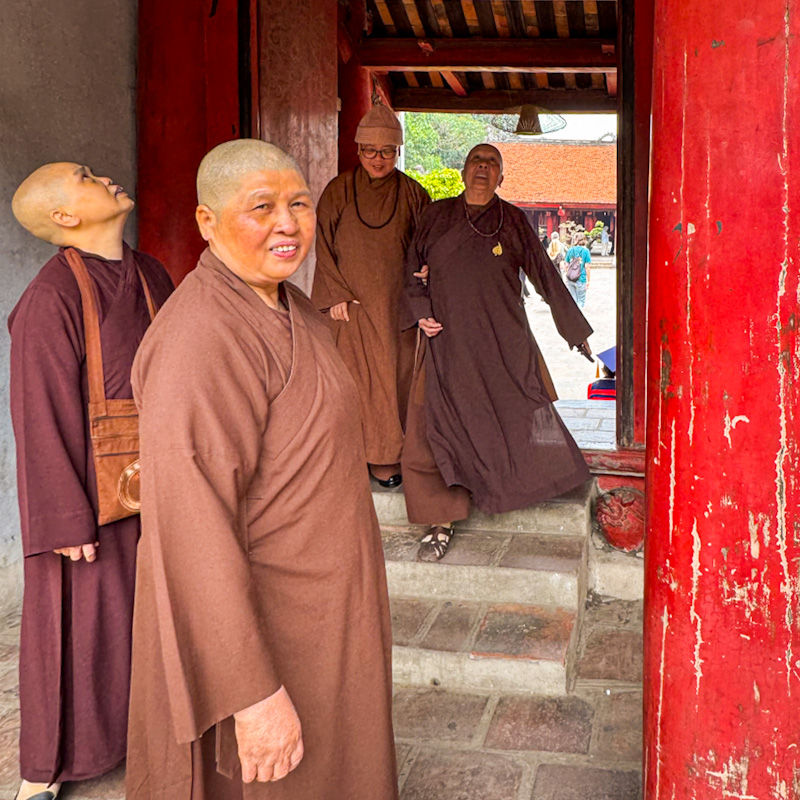
Since Ho Chi Minh Complex and the temples near West Lake are outside Hanoi Old Quarter, GrabCar became our go-to to skip the long walks in the smog. We cover this part of the city in more detail in our Things to Do in Hanoi Old Quarter (and Beyond) guide.
DAY 12: HANOI TO HA LONG BAY
Whether you’re heading to Ha Long Bay or, better yet, following our advice to visit Lan Ha Bay, you’ll arrive at the harbour in a so-called “luxury limousine”, aka a minivan in its Sunday best with cushy seats and air con. A round-trip shared transfer is usually included in the cruise price, as it was for ours.
If it’s not, there’s no shortage of well-reviewed shared or private transfer options to choose from.
DAY 13: HA LONG BAY / LAN HA BAY

This wasn’t your typical Ha Long Bay “luxury” cruise, with boats packed tighter than beach towels in July, over 200 ships anchoring overnight, and a neighbouring vessel massacring Backstreet Boys on karaoke until 2AM.
Short of chartering your own yacht, Elite of the Seas is as good as it gets, swaddling you in rom-com levels of luxury, complete with acoustic guitars, falling rose petals, and a personal butler.
While the route includes UNESCO-listed Ha Long Bay, most of the time is spent in Lan Ha Bay — smaller, quieter, greener, and far more exclusive, with around 60 boats and wild orchids that give the bay its name, “descending orchid.”
Curious whether it’s worth the splurge? Read We Paid US$1,274 for a Ha Long Bay Luxury Cruise — Would We Do It Again?
DAY 14: RETURN TO HANOI
After a leisurely breakfast onboard, you’ll head back to your Hanoi hotel via the same route, giving you a final evening to soak up the city before departing for home tomorrow.
WHAT WE SPENT
Curious what a luxury trip to Vietnam actually costs? We tracked everything from including a few bucket list splurges, so you can see what two people might spend travelling comfortably and well for 14 days plus 2 international travel days.
Costs are based on a condensed version of our 3 week trip, adapted for a 2 week itinerary. We’ve assumed a £45 pp flight from Da Nang (DAD) to Hanoi (HAN) (our original DAD–THD flight cost more) and a smaller Airalo data package than the £26, 20GB / 30-day plan we used.

FX: 1 GBP = 1.15 EUR / 1.38 USD
FREQUENTLY ASKED QUESTIONS
Do I need a visa for Vietnam?
If you're a UK citizen you can visit Vietnam for up to 45 days without a visa. Here's a list of countries exempt from visas. If you're a US citizen, a visa is required for any stay.
Your passport must be undamaged, valid for at least 6 months from arrival, and have two blank pages. Visa rules can change, so double-check official government guidance before you fly.
What's the best month to visit Vietnam?
Vietnam’s dry season runs from November to April, making it the most popular time for sightseeing.
That said, weather varies by region:
North Vietnam: Nov–Mar is cooler and drier
Central Vietnam: Jan–Aug brings beach weather
South Vietnam: Nov–Apr is warm and dry
We traveled late March to early April, and it was mostly dry and partly sunny with just two hiccups: a rainy day in Ninh Binh (bring a light jacket!) and a quick shower our last night in Hanoi. If you’re travelling the length of the country, expect a bit of weather variety rather than one perfect forecast everywhere.
How long to spend in Vietnam?
2 weeks works brilliantly in Vietnam if you follow a streamlined route with sensible travel days. You'll see the highlights without constantly packing up your bags. With 3 weeks, you can slow things down further and add a few quieter, off-the-radar stops such as the Mekong Delta and Pu Luong Nature Reserve.
Is tap water safe to drink in Vietnam?
No. Stick to bottled or boiled water, and that includes brushing your teeth!
What vaccinations do I need for Vietnam?
No vaccinations are required for entry, but it’s sensible to be up to date on routine jabs unless advised otherwise by your doctor. We chose to get rabies, as Vietnam is considered high-risk by the WHO, and Japanese encephalitis due to time spent near rice fields and rural areas (included in our 3 week Vietnam itinerary).
Are mosquitos a problem when visiting Vietnam?
Mosquitos are part of life in Vietnam, but they’re rarely the trip-ruining menace people fear. You’ll notice them more around water, rice fields, and at dawn and dusk, and yes, dengue is spread by day-biting mosquitos, particularly in cities.
A decent repellent (i.e. 50% DEET) plus covering up a little in the early morning and late afternoon, goes a long way.
What's the best mosquito repellent for Vietnam?
We saw mosquito repellent for sale in Vietnam, but most local stuff doesn’t pack enough DEET to truly keep the biters at bay. So we came prepared with three trusty 100ml cans of LifeSystems Expedition Max (50% DEET).
We applied it like sunblock (BUT after sunblock): spraying a bit into our hands, then rubbing it on, including a careful dab on our faces and even a sweep through our hair. Needless to say, keep it out of your eyes, off your contact lenses, and far away from any open cuts. Whenever we wore this repellant, we did not get bitten.
Is Vietnam safe to visit?
Yes, Vietnam is generally safe, with low violent crime and a welcoming vibe. The main thing to watch for is petty theft, particularly bag snatching and pickpocketing in busy areas, often involving passing motorbikes. Keep valuables zipped and close, use basic street smarts, and you’ll be fine.
We felt safe, but the UK government's advice on safety and security is definitely worth a read.
Is Vietnam cheap?
Vietnam is refreshingly affordable for travellers, particularly when it comes to comfort and experiences. Luxury hotels, private transfers, spa treatments, and memorable splurges cost far less than in Europe or North America, making it one of the easiest places to travel well on a reasonable budget. See what we spent above.
What currency is Vietnam?
Vietnam uses the Vietnamese dong (VND). Tourist prices are often listed in USD, but you’ll still pay in VND at the day’s exchange rate.
Should I carry cash or use cards in Vietnam?
Cash is king, and card payments often come with fees if they’re accepted at all. Paying by card? Always choose VND, not your home currency, to avoid unnecessary fees.
Most ATMs accept foreign cards, with a typical withdrawal limit of VND 3,000,000 per transaction (converted: £84 / €96 / US$115). Multiple withdrawals are usually allowed.
Should I travel North to South or South to North in Vietnam?
Most international flights arrive into Ho Chi Minh City (SGN) in the south or Hanoi (HAN) in the north. Both are excellent starting points, making it easy to plan a south-to-north route or vice versa. With that said, the season should dictate your direction of travel.
Spring (Feb–Apr): South to North: Follow improving weather as the north warms up and clears. This is what we did since we travelled Mar-Apr.
Summer (May–Aug): Either direction: Hot and humid everywhere, so route choice matters less.
Autumn (Sep–Oct): North to South: Start with the north at its best and move south as rain increases.
Winter (Nov–Jan): North to South: Finish in the south’s sunshine rather than the north’s mist.
How many days in Hoi An vs Hanoi vs Ho Chi Minh City?
What most people do:
Travellers often spend 3–4 days in Hanoi, 2–3 days in Ho Chi Minh City, and 2–3 days in Hoi An, with Hanoi’s longer stay usually accounting for nearby add-ons like Ha Long Bay or Ninh Binh.
What we did:
We treated Ha Long Bay as a separate 3-day experience, spent 2 full days in Ninh Binh, kept Hanoi to 2 days, did 2 days in Ho Chi Minh City and gave Hoi An 3 days to allow for two day trips.
What is the best way to get around Vietnam for 2 weeks?
In cities, GrabCar is cheap, reliable, and far less chaotic than hailing taxis or paying hotel transfer prices. Between nearby cities or rural areas, reputable private car transfers are worth every dong. For long distances, internal flights are fast, affordable, and save a huge amount of time.
Is Grab available in Vietnam?
In cities, GrabCar is cheap, reliable, and far less chaotic than hailing taxis or paying hotel transfer prices. Download the app, link your credit card or book rides and pay in cash.
We took GrabCar everywhere in Ho Chi Minh City and Hanoi. Walking through the endless sea of motorbikes felt like a full-contact sport, and we used GrabCar in Ninh Binh too since the sights were pretty spread out. We also used GrabCar in Hoi An to get to Da Nang airport from Ancient Town.
Pin this for later!
FOLLOW US ON PINTEREST